In discussions concerning doping in equestrian sport, the regulatory and public focus has traditionally been directed primarily toward the horse, rather than the conduct of human participants. Horses, like athletes in other sports, may be administered certain substances to enhance their performance during competition, enabling them to run faster, jump higher, recover faster, increase endurance, or feel less pain. In some cases, prohibited substances have been used to mask lameness or other physical conditions, allowing horses to compete or perform successfully in pre-purchase examinations.
Moreover, in the so-called controlled medication cases where a medical treatment with a certain substance is allowed by the Fédération Équestre Internationale (FEI) or Horseracing Integrity and Safety Authority (HISA) outside of competition, the medication itself (and even the withdrawal time) can also lead to a positive doping/controlled medication violation in competition.
Combating equine doping – defined as the administration of prohibited substances to horses in equestrian sport – remains a central regulatory priority. The FEI applies a strict liability framework and enforces a zero-tolerance policy, handling a significant number of cases each year. Decisions of the FEI Tribunal consistently reflect the ongoing legal and regulatory challenges associated with doping control and integrity within the sport.
The Role and Liability of the Rider: Human Doping in Equestrian Sports
In addition to equine doping, anti-doping rules in equestrian sport also apply to the human athlete, namely the rider. Doping controls for riders are increasingly carried out at major international events, including the Olympic Games, the European Championships, and the Asian or Pan American Games. Riders who violate anti-doping rules can face serious consequences, such as suspensions, disqualification, and damage to their reputation.
Applicable Rules and Regulatory Framework for Doping
To understand the rules that govern (human) doping in equestrian sports, it is essential to understand the basic structure of the framework that governs international sports in general.
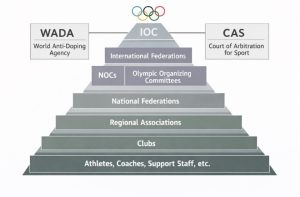
Most sports, including most equestrian sports, are governed by a hierarchical pyramid structure in a top to bottom governance system. At the very top of that pyramid stands the International Olympic Committee (IOC) followed by National Olympic Committees, Organizing Committee of the Olympic Games and the International Federations, such as the FEI. From there follow the National Federations, possible Regional Associations, Clubs and then at the very bottom the athletes and other individuals involved in the sport.
Therefore, all sports that fall under the governance of the IOC share the values of the Olympic movement and the mission of the IOC, including fair play. Fair play, as one of the key components of sport, involves the fight against doping.
The most important body in the fight against doping is the World Anti-Doping Agency (WADA). While not directly part of the pyramid structure that governs most sports, WADA nonetheless has direct influence on the IOC and therefore on all sports that are governed by the IOC. The World Anti-Doping Code (the “WADA Code”) “is the fundamental and universal document upon which the World Anti-Doping Program in sport is based. The purpose of the Code is to advance the anti-doping effort through universal harmonization of core anti-doping elements.”[i] The WADA Code has a section dedicated to the Role and responsibilities of the IOC which requires the IOC, “as a condition of recognition by the International Olympic Committee, that International Federations and National Olympic Committees within the Olympic Movement are in compliance with the Code and the International Standards.”[ii]
Accordingly, if a sport wants to be part of the Olympic Movement and wants to be recognized by the IOC, it must comply with the WADA Code. The WADA Code also addresses International Federations specifically by requiring them “[t]o adopt and implement anti-doping policies and rules which conform with the Code and International Standards.”[iii] Furthermore, International Federations are obliged “[t]o require, as a condition of membership, that the policies, rules and programs of their National Federations and other members are in compliance with the Code and the International Standards, and to take appropriate action to enforce such compliance”.[iv] The WADA Code is open for signatures by International Federations, Major Event Organizers, National Olympic Committees, National Paralympic Committees, National Anti-Doping Organizations and Other Organizers having significant relevance in sport.[v]
Since the FEI is an International Federation recognized by the IOC it is also obliged to enforce compliance with the WADA Code. It is important to understand that it is not the individual athlete who signs the WADA Code and is thereby obliged to comply with the anti-doping rules laid down therein. It is through the top-to-bottom governance structure that athletes who are FEI members and compete in FEI events are obliged to comply with the WADA Code. As part of the FEI Rules & Regulations, all riders must adhere to the FEI Anti-Doping Rules for Human Athletes (the “ADRHA”). In turn, the FEI’s ADRs are adopted and implemented in accordance with the WADA Code.³
Anti-Doping Rule Violations under the ADRHA
Article 1 of the ADRHA defines doping “as the occurrence of one or more of the anti-doping rule violations set forth in Article 2.1 through Article 2.11 of these Anti-Doping Rules.”[vi] The wording is almost identical to the one that can be found in the WADA Code.
Doping goes far beyond the typical association of using performance enhancing substances. The ADRHA lays down 11 violations[vii] which fall under the definition of doping in connection with the ADRHA and the WADA code:
- Presence of a Prohibited Substance or its Metabolites or Markers in an Athlete’s Sample
- Use or Attempted Use by an Athlete of a Prohibited Substance or a Prohibited Method
- Evading, Refusing or Failing to Submit to Sample Collection by an Athlete
- Whereabouts Failures by an Athlete
- Tampering or Attempted Tampering with any Part of Doping Control by an Athlete or Other Person
- Possession of a Prohibited Substance or a Prohibited Method by an Athlete or Athlete Support Person
- Trafficking or Attempted Trafficking in any Prohibited Substance or Prohibited Method by an Athlete or Other Person
- Administration or Attempted Administration by an Athlete or Other Person to any Athlete
- Complicity or Attempted Complicity by an Athlete or Other Person
- Prohibited Association by an Athlete or Other Person
- Acts by an Athlete or Other Person to Discourage or Retaliate Against Reporting to Authorities
The Prohibited List
The ADRHA set out a list of prohibited substances and methods, which incorporate the Prohibited List as published and annually revised by WADA (pursuant to Article 4.1 of the 2021 WADA Code).⁵ A key distinction is drawn between three categories:
- Prohibited Substances and Methods
- Those which are banned at all times, whether in or out of competition, “because of their potential to enhance performance in future Competitions or their masking potential”[viii]; and
- those prohibited in-competition only.
- Specified Substances and Methods
Those which are “which are more likely to have been consumed or used by an Athlete for a purpose other than the enhancement of sport performance” [ix]; and
- Substances of Abuse
Those which “are frequently misused in society outside of the context of sport.”⁵
Human Doping in Equestrian Sport: Therapeutic Use Exemptions (TUEs)
An athlete who requires a prohibited substance for legitimate medical reasons may apply for a Therapeutic Use Exemption (TUE). The WADA Code includes a separate document called the International Standard Therapeutic Use Exemptions (2023). This document governs next to Article 4.4 of the WADA Code all aspects around a TUE.
A TUE permits the use of an otherwise prohibited substance or method for documented medical purposes and may be granted only if an athlete can show, on the balance of probabilities, that four specific conditions are met. (i) The prohibited substance or method must be medically necessary to diagnose or treat a documented condition (and may be part of a necessary diagnostic investigation), supported by relevant clinical evidence. (ii) Its therapeutic use must not be expected to enhance performance beyond restoring the athlete to their normal state of health, (iii) there must be no reasonable permitted alternative treatment, and (iv) the need for treatment must not result from prior use of a prohibited substance or method without a TUE. TUE decisions are made solely against these criteria and do not consider broader issues such as overall clinical appropriateness, safety, or legality in different jurisdictions.[x] Athletes are strongly advised to apply for a TUE before using any potentially prohibited medication and to seek expert legal or medical advice in case of doubt.
A Comparison between the WADA Code and National Law
The ADRHA are sports rules and, as such, they are fundamentally distinct in character from criminal or civil law. According to the WADA Code the rules “are not intended to be subject to or limited by any national requirements and legal standards applicable to criminal or civil proceedings, although they are intended to be applied in a manner which respects the principles of proportionality and human rights.”[xi] How the WADA Code differs from various national criminal or civil proceedings can be illustrated by the example of cocaine. To illustrate this difference, it is instructive to compare the applicable thresholds under the WADA Code and Dutch criminal law.
Under Dutch law, in order to charge a driver with driving under the influence of cocaine, the police must establish that the blood sample taken contains at least 50 ng/mL, [xii] whereas, under the WADA Prohibited List, an in-competition use of cocaine is most likely to be established where the analytical concentrations reported by a WADA-accredited laboratory show either: (i) the presence of the cocaine parent compound at an estimated urinary concentration above (>) 10 ng/mL; or (ii) the presence of benzoylecgonine (main metabolite of cocaine) at a urinary concentration above (>) 1000 ng/mL combined with the presence of the cocaine parent compound between (≥) 1 ng/mL and (≤) 10 ng/mL.[xiii]
This example clearly demonstrates that athletes should be aware that the WADA Code is much stricter than national legislation in many respects. Even a brief contact with a residue of a prohibited substance may be sufficient to trigger a positive doping test. It is therefore advisable to limit any exposure to such risks around major sporting events. In practice, this requires athletes to exercise heightened vigilance and attention in situations where possible (involuntary) contact or contamination can occur. It is important to keep in mind that the athlete is subject to strict liability when it comes to anti-doping rules.
Strict Liability and the Athlete’s Burden of Proof
A fundamental feature of anti-doping law is its departure from the presumption of innocence familiar from criminal law. While the burden of proof that a doping violation occurred lies with the FEI[xiv] (in Equestrian Sports), “the standard of proof shall be whether the FEI has established an anti-doping rule violation to the comfortable satisfaction [which] in all cases is greater than a mere balance of probability but less than proof beyond a reasonable doubt.”[xv] Pursuant to Article 2.1.2 ADRHA, sufficient proof of a doping violation for the presence of a Prohibited Substance or its Metabolites or Markers is established by the mere presence of a prohibited substance in the athlete’s A-sample¹⁰ (one of the two blood-samples – A and B – collected during the doping-test). It is therefore strongly advisable for any athlete accused of a doping violation to promptly request analysis of the B-sample, wherever possible, as this can be a critical safeguard in mounting a defence.
“It is the Athletes’ personal duty to ensure that no Prohibited Substance enters their bodies. Athletes are responsible for any Prohibited Substance or its Metabolites or Markers found to be present in their Samples. Accordingly, it is not necessary that intent, Fault, Negligence or knowing Use on the Athlete’s part be demonstrated in order to establish an anti-doping rule violation under Article 2.1.”[xvi]
Under the principle of strict liability, the mere presence of a prohibited substance in an athlete’s sample constitutes a violation, regardless of intent, knowledge, or negligence. Once a violation is established under the ADRHA, the burden shifts entirely to the athlete to demonstrate how the substance entered their body. Establishing the absence of fault or negligence – or at minimum, no significant fault or negligence – is a demanding evidentiary threshold. However, it is the only avenue through which the otherwise mandatory period of ineligibility may be reduced or, in exceptional circumstances, eliminated entirely.
This principle applies equally in cases where team doctors or other medical professionals provide medication to athletes with the assurance that it is safe to use, but it subsequently turns out to contain a prohibited substance. Reliance on a medical professional’s advice does not eliminate the athlete’s strict liability. It may, however, be relevant to the assessment of the athlete’s degree of fault for sanctioning purposes – in particular, whether the athlete exercised reasonable caution in seeking and verifying that advice. Athletes are therefore strongly advised to independently verify the permitted status of any medication prior to use.[xvii]
Proceedings Before the FEI Tribunal
For any person allegedly involved in a doping violation, “the FEI shall provide a fair hearing within a reasonable time by a fair, impartial and Operationally Independent hearing panel in compliance with the Code and the International Standard for Results Management.”[xviii] This function is fulfilled by the FEI Tribunal, which was established under Article 38 of the FEI Statutes and operates under the Internal Regulations of the FEI Tribunal (4th edition, in force as of 1 February 2025). In some cases, the FEI will try to reach a settlement, which often will consist of the prompt admission of the alleged violation in return for a reduction of the sanction. Otherwise, the FEI Tribunal will hear the parties concerned and rule on the matter. Importantly, decisions of the FEI Tribunal may be appealed to the Court of Arbitration for Sport (CAS) in Lausanne, whose decisions are final and binding.
Consequences of Anti-Doping Rule Violations
While this article has focused primarily on the anti-doping rule violation concerning the presence of a prohibited substance, it has also highlighted ten further categories of violations under the ADRHA. Since these violations differ significantly in their underlying conduct, the applicable consequences also vary considerably. Sanctions range from disqualification of results and provisional suspensions to fines and periods of ineligibility, and it is important to note that multiple sanctions may be imposed cumulatively. Article 10 of the ADRHA sets out the applicable sanctions in detail.
The determination of ineligibility periods is particularly complex and is highly dependent on a combination of factors: the type and gravity of the violation, the specific circumstances and any available justifications, a finding of no fault or negligence or no significant fault or negligence, the existence of prior or concurrent violations, and any aggravating circumstances. Depending on the interplay of these factors, the standard period of ineligibility may be increased, reduced, or – in exceptional circumstances – eliminated entirely. Athletes or others who find themselves facing potential violations are therefore strongly advised to seek specialist legal advice at the earliest opportunity.
Conclusion: Human Doping in Equestrian Sport
As the foregoing demonstrates, equestrian sport operates within a robust and strictly enforced anti-doping framework. The consequences of a violation – for both horse and rider – can be severe and career-defining. Awareness of the applicable rules, proactive compliance, and early legal advice are therefore essential for any participant in international equestrian sport.
While equine anti-doping policy is primarily driven by considerations of horse welfare, it is essential to recognize that equestrian sport is unique in involving two athletes — one human, one equine. Human athletes are equally subject to the full rigour of anti-doping regulation and may face equally serious consequences if they themselves are found to be in violation of such regulations. As shown above, anti-doping rule violations extend well beyond the presence or use of prohibited substances. Athletes are strictly liable and therefore should be aware of the full scope of the anti-doping rule regulations.
Disclaimer
This article serves as an introduction to the subject matter addressed and is provided solely for general informational purposes. It does not constitute legal advice, nor does it establish an attorney-client relationship between the reader and our firm. No rights may be derived from the contents of this article.
Although every effort has been made to ensure accuracy, no warranty is given as to the completeness or currency of the information presented. The law is subject to change, and its application will vary depending on the specific circumstances of each situation.
Readers should not act or refrain from acting on the basis of this article without first seeking specific legal advice tailored to their situation. Our firm excludes all liability for any loss or damage arising from reliance on the information contained herein, to the fullest extent permitted by applicable Dutch law.
Legal Assistance in Doping Cases
Schelstraete Equine Law provides strategic legal advice and representation in disputes concerning equestrian doping and human doping. Our equine lawyers have acted for various prominent equestrians in proceedings before the Court of Arbitration for Sport, the FEI and national equestrian federations around the world.
Written by Lara Schönherr, P.M. Wawrzyniak, S.Elderson Nosti
Sources
[i] World Anti-Doping Agency. (2021). World Anti-Doping Code 2021. World Anti-Doping Agency. p. 9
[ii] Ibid. Art. 20.1.2
[iii] Ibid. Art. 20.3.1
[iv] Ibid. Art. 20.3.2
[v] Fédération Équestre Internationale. (2024). FEI Anti-Doping Rules for Human Athletes. Fédération Équestre Internationale. Art. 4.2
[vi] Ibid. Art. 1
[vii] Ibid. Art. 2
[viii] World Anti-Doping Agency. Code Signatories. https://www.wada-ama.org/en/what-we-do/world-anti-doping-code/code-signatories
[ix] World Anti-Doping Agency. (2021). World Anti-Doping Code 2021. World Anti-Doping Agency. p. 32, Footnote 26
[x] World Anti-Doping Agency. (2021). International Standard for Therapeutic Use Exemptions. World Anti-Doping Agency. Art. 4.2
[xi] World Anti-Doping Agency. (2021). World Anti-Doping Code 2021. World Anti-Doping Agency. p. 17
[xii] wetten.nl – Regeling – Besluit alcohol, drugs en geneesmiddelen in het verkeer – BWBR0038936. (2022, July 1). Art. 3.1(c). https://wetten.overheid.nl/BWBR0038936/2022-07-01
[xiii] World Anti-Doping Agency. (2021). Substances of abuse under the 2021 World Anti-Doping Code: Guidance note for anti-doping organizations. World Anti-Doping Agency.
[xiv] Fédération Équestre Internationale. (2024). FEI Anti-Doping Rules for Human Athletes. Fédération Équestre Internationale. Art. 3.1
[xv] Ibid
[xvi] Ibid. Art. 2.1.1
[xvii] CAS 2017/A/5015 & 2017/A/5110, International Ski Federation (FIS) v. Therese Johaug & Norwegian Olympic and Paralympic Committee and Confederation of Sports (NIF); Therese Johaug v. NIF, Award of 21 August 2017.
[xviii] Fédération Équestre Internationale. (2024). FEI Anti-Doping Rules for Human Athletes. Fédération Équestre Internationale. Art. 8