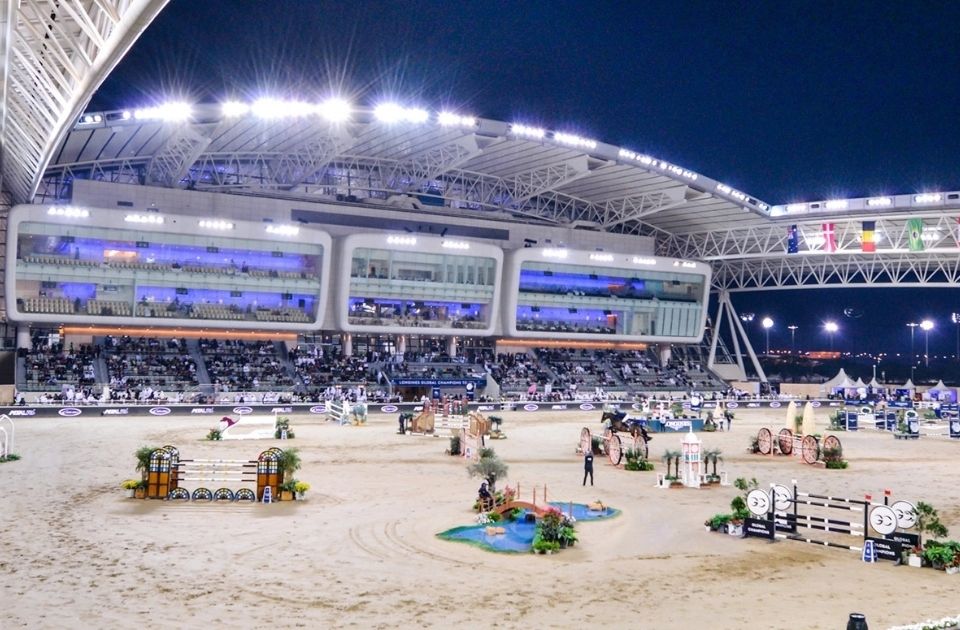
In late February 2026, the Gulf region experienced a swift and serious escalation of military hostilities. Joint American and Israeli strikes on Iran triggered retaliatory responses affecting Qatar, Bahrain, the United Arab Emirates, and Saudi Arabia, causing widespread airspace closures that rendered international horse transport physically impossible.[i]
The consequences were immediate. The season-opening CSI5* GCT/GCL, CSI3* and CSI1* at the Al Shaqab Equestrian Centre in Doha (4–7 March 2026) and the CSI2* in Al Ain, UAE (4–8 March 2026) were both cancelled.[ii] With horses and personnel already on-site, organisers and participants faced not only the question of whether competition could proceed, but the urgent challenge of securing safe repatriation for all involved.[iii]
This article analyses how force majeure operates in sport generally and within the FEI regulatory framework specifically, using the Doha events as an example, and why clear and timely communication is as important as the legal doctrine itself.
What is Force Majeure in Sports Law?
Force majeure — from the French for “superior force” and sometimes referred to as “Act of God”— is a legal doctrine that excuses a party from contractual performance when an extraordinary event beyond their control renders performance impossible. As a general principle, a force majeure clause “operates to alter the parties’ obligations/liabilities under a contract when an event or circumstance — a force majeure event which is beyond their control — prevents one or both of them from fulfilling their contractual obligations.”[iv]
Force majeure clauses are common in commercial contracts, though their drafting varies considerably. The approach also differs across jurisdictions: in England, qualifying events must be defined by the contracting parties.[v] In international sports law, by contrast, tribunals apply civil law principles and recognise force majeure even in the absence of specific contractual language.[vi]
CAS Approach to Force Majeure
Before the Court of Arbitration for Sport (CAS), force majeure is considered “widely and internationally accepted and, in particular, valid and applicable under Swiss law” and constitutes “a well-established doctrine” in CAS case law.[vii] CAS panels apply it narrowly, however, requiring that a qualifying event constitute an “objective (rather than a personal) impediment beyond the control of the “obliged party”, that is unforeseeable, that cannot be resisted, and that renders the performance of the obligation impossible […].”[viii] As confirmed by settled CAS jurisprudence, “the conditions for the occurrence of force majeure are to be narrowly interpreted, since force majeure introduces an exception to the binding force of an obligation.“[ix]
The distinction between impossible and merely difficult is decisive. In Fédération Royale Marocaine de Football v. Confédération Africaine de Football (CAS 2015/A/3920), force majeure was rejected because an alternative organiser successfully staged the same competition on the same dates. The CAS panel held that the organisation of the competition was not impossible, but only “difficult,” and that a solution had demonstrably been available.[x] By contrast, in Alexandria Union Club v. Juan José Sánchez Maqueda & Antonio Cazorla Reche (CAS 2014/A/3463 & 3464), the sole arbitrator accepted that the Egyptian civil war constituted force majeure, finding expressly that it was “beyond the Parties’ control, which the Parties could not have reasonably provided against before entering into the contract, which could not reasonably have been avoided or overcome, and which is not attributable to any of the Parties.”[xi] That reasoning applies directly to Doha: active armed conflict rendered the continuation of sporting activities physically impossible, independent of any party’s choices or conduct.
Force majeure is a legal tool requiring rigorous, well-grounded invocation, not a general escape clause for inconvenience.
How Force Majeure Is Handled by the FEI
Within the FEI regulatory framework, force majeure is not left to interpretation. It is explicitly defined, procedurally embedded, and supported by a liability framework.
Definition
Appendix A of the FEI General Regulations (2026) defines a Force Majeure Event as:
“Any event or circumstance arising from or attributable to acts, events, omission or accidents which are not reasonably foreseeable by, and which are beyond the reasonable control of and which could not have been reasonably prevented by, a party…”[xii]
The definition includes, by way of non-exhaustive example: abnormally inclement weather, flood, fire, earthquake and critically, war and military operations, as well as government-imposed restrictions.[xiii] The Doha conflict fell squarely within this language.
Cancellation of Events
Article 109.13 of the FEI General Regulations establishes a mandatory consultation and decision-making procedure when safety is at stake:
“Subject to the unanimous agreement of the President of the Ground Jury, Technical Delegate and President of the Veterinary Committee in consultation with the Organiser, a Competition (either before or during) can be postponed and/or cancelled […] due to force majeure […] and in specific situations where the welfare or safety of the Horses, Athletes, Officials or the public is compromised.”[xiv]
This provision expressly permits cancellation or postponement on force majeure grounds, as well as in any situation where the welfare or safety of horses, athletes, officials, or the public is compromised. Notably, cancellation fees do not apply where an event is cancelled due to a Force Majeure Event which is a significant financial protection.[xv]
Liability
The FEI expressly excludes its liability for delayed, cancelled or rescheduled events. Article 171.2 of the FEI General Regulations provides that “the FEI shall not be liable to any persons or entities for any loss incurred as a result of a delayed, cancelled or rescheduled Competition and/or Event.“[xvi]
FEI Tournaments In Middle East Cancelled
Why the Force Majeure Threshold Was Met
Force majeure is a high threshold. The events of early March 2026 met that threshold:
- Active military conflict in the competition region. Iranian retaliatory strikes targeting Qatar, Bahrain, the UAE, and Saudi Arabia created conditions of active war in the immediate region.[xvii]
- Airspace closures rendered horse transportation physically impossible. Cargo flights could not operate, meaning horses on-site could not depart and incoming horses could not arrive.[xviii]
- Athlete and official safety was directly at risk. Multiple governments issued warnings against travel to the region, and the FEI advised all participants to follow governmental guidance.[xix] Competing in an active war zone constitutes, by any standard, an unacceptable risk to human life.
- It was impossible and not merely inconvenient or difficult to hold the Event.
The FEI Response and Cancellation
On 2 March 2026, the FEI issued its official statement confirming the cancellation of:[xx]
- CSI5* GCT/GCL, CSI3* and CSI1* in Doha, Al Shaqab (QAT): 4–7 March 2026
- CSI2* in Al Ain (UAE): 4–8 March 2026
The Longines Global Champions Tour (LGCT) and the Doha Equestrian Tour confirmed jointly that the event “will not proceed on these dates due to the current situation in the region,” citing “careful assessment of airspace restrictions, participation travel timelines and overall operational limitations.“[xxi]
By 9 March 2026, all 147 horses had been safely repatriated to Europe on two flights.[xxii]
Precedent: The COVID-19 Cancellations
The Doha cancellation is not the first time force majeure has reshaped the equestrian calendar. In March 2020, the FEI, United States Equestrian (USEF), and Las Vegas Events announced the “force majeure cancellation” of the FEI World Cup Finals 2020 in Las Vegas, the first cancellation in the Finals’ then 41-year history, due to the COVID-19 pandemic and US government travel restrictions.[xxiii] FEI President Ingmar De Vos stated: “The decision was out of our hands.“[xxiv]
The Importance of Effective Communication in Force Majeure Situations
A force majeure event does not simply suspend obligations, it creates a vacuum of uncertainty that can cause significant harm to athletes, teams, horses, and commercial partners unless addressed promptly and clearly. How stakeholders communicate during and after a force majeure event is as important as the legal doctrine itself.
Crisis Communication Regarding Doha Events
The FEI’s statement of 2 March 2026 demonstrated three key elements of effective crisis communication:[xxv]
- It provided immediate clarity on cancellations.
- It provided a clear statement that no negative consequences would follow for athletes due to not participating in the events.
- It directed stakeholders to appropriate channels for consultation on the situation.
Liability in Force Majeure Situations
Contractual Exclusion of Liability
A force majeure clause serves a specific and practical function in commercial contracts: it “operates to alter the parties’ obligations/liabilities under a contract when an event or circumstance – a force majeure event which is beyond their control – prevents one or both of them from fulfilling their contractual obligations.”[xxvi] When successfully invoked, the affected party is ordinarily excused from performance without liability for damages. However, the scope and effect of that protection depends critically on the legal tradition governing the contract.
In common law jurisdictions, such as England and Wales, force majeure is largely a creature of contract and is typically not codified in statute.[xxvii] It is for the contracting parties themselves to define which events will qualify, the applicable causation requirements, and the precise consequences.[xxviii] In this tradition, force majeure clauses operate, in effect, as exclusion clauses and are interpreted relatively restrictively by courts.[xxix]
In civil law jurisdictions, by contrast, force majeure is typically enshrined in statute, and courts may apply the doctrine even in the absence of specific contractual language.[xxx] Parties are often bound by the parameters defined by legislation rather than being free to prescribe the doctrine’s scope entirely at will.
To provide the best protection in case of force majeure events, the contracting parties should clearly establish liability in their agreement.
Insurance
The intersection of insurance law and force majeure presents a critical dimension of risk management for event organisers, participants, and commercial partners in international sport. A fundamental distinction must first be drawn: while a force majeure clause may relieve a contracting party of its obligations, it does not, in and of itself, generate an entitlement to financial compensation under an insurance policy.[xxxi] Whether insurance coverage is in fact triggered and what it compensates depends entirely upon the specific wording of the applicable policy. If a force majeure event is not covered in the insurance policy, the insurance company may not be liable to cover the damages,[xxxii] and even where coverage exists, “insurance policies often set limits on the coverage amounts for damages resulting from such events.“[xxxiii] The determinative factor is therefore policy drafting: “the success of an insurance claim is primarily determined by the specific wording of the policy, especially the force majeure clause, the insurable risks clause, and any exceptions listed.“[xxxiv] Policyholders must also be alert to common exclusions. Standard policies frequently exclude acts of war, terrorism, and intentional actions.[xxxv] Ultimately, “the allocation of risk will depend on the wording of the relevant contracts and the scope of any applicable insurance cover,“[xxxvi] and policyholders are well advised to review their policies carefully, consider bespoke additional cover for war and civil unrest risks, and take note of exclusions before a crisis occurs rather than after.[xxxvii]
Conclusion
The COVID-19 pandemic and the 2026 Gulf conflict have each demonstrated that force majeure is not a theoretical concept — it is a practical reality that organisers, federations, and participants in international sport must be prepared to navigate. The legal framework, whether through regulatory provisions such as those of the FEI, CAS jurisprudence, or contractual drafting, provides the foundation. But the framework alone is insufficient. Insurance for force majeure events must be taken with a grain of salt and should always be considered carefully. When a force majeure event occurs, timely and authoritative communication is essential to prevent uncertainty, protect participants from unwarranted regulatory consequences, and enable coordinated action. Above all, the welfare and safety of horses, athletes, officials, and the public must take precedence over any competitive or commercial consideration.
Disclaimer
This article serves as an introduction to the subject matter addressed and is provided solely for general informational purposes. It does not constitute legal advice, nor does it establish an attorney-client relationship between the reader and our firm. No rights may be derived from the contents of this article.
Although every effort has been made to ensure accuracy, no warranty is given as to the completeness or currency of the information presented. The law is subject to change, and its application will vary depending on the specific circumstances of each situation.
Readers should not act or refrain from acting on the basis of this article without first seeking specific legal advice tailored to their situation. Our firm excludes all liability for any loss or damage arising from reliance on the information contained herein, to the fullest extent permitted by applicable Dutch law.
For legal advice specific to your situation, please contact our office at info@schelstraete.com.
Luc Schelstraete; Piotr Wawrzyniak; Lara Schönherr
Sources
[i] Equnews Editorial. (2026, February 28). Uncertainty surrounds Global Champions Tour Start Following Gulf Region Escalation!: “No official decision yet, the situation is evolving minute by minute!” Equnews International. https://equnews.com/article/showjumping-en/uncertainty-surrounds-global-champions-tour-start-following-gulf-region-escalation-no-official-decision-yet-the-situation-is-evolving-minute-by-minute
[ii] Fédération Équestre Internationale. (2026, March 2). FEI issues security update and cancellations for upcoming FEI Events in the Middle East. FEI. https://inside.fei.org/content/fei-issues-security-update-and-cancellations-upcoming-fei-events-middle-east; Martuscelli, U. (2026, March 2). Middle East: Competitions cancelled. Cavallo Magazine. https://www.cavallomagazine.it/en/sport-equestri/salto-ostacoli/medio-oriente-concorsi-cancellati
[iii] Equnews Editorial. (2026, February 28). Uncertainty surrounds Global Champions Tour Start Following Gulf Region Escalation!: “No official decision yet, the situation is evolving minute by minute!” Equnews International. https://equnews.com/article/showjumping-en/uncertainty-surrounds-global-champions-tour-start-following-gulf-region-escalation-no-official-decision-yet-the-situation-is-evolving-minute-by-minute
[iv] Diaz-Rainey, J. (2020, March 20). Coronavirus: Force majeure, sport and entertainment. Pinsent Masons. Out-Law Analysis. https://www.pinsentmasons.com/out-law/analysis/coronavirus-force-majeure-sport-entertainment
[v] Ibid
[vi] Morgan Sports Law. (2020, April 10). COVID-19 — Force majeure: Swiss law, CAS jurisprudence, and the jurisprudence of other sports tribunals. Morgan Sports Law. https://www.morgansl.com/en/latest/covid-19-outbreak-force-majeure-swiss-law-cas-jurisprudence-jurisprudence-other-sports-tribunals
[vii] CAS 2018/A/5779 Zamalek Sporting Club v. FIFA, para. 58 as cited in Morgan Sports Law. (2020, April 10). COVID-19 — Force majeure: Swiss law, CAS jurisprudence, and the jurisprudence of other sports tribunals. Morgan Sports Law. https://www.morgansl.com/en/latest/covid-19-outbreak-force-majeure-swiss-law-cas-jurisprudence-jurisprudence-other-sports-tribunals
[viii] CAS 2018/A/5779 Zamalek Sporting Club v. FIFA, para 60 as cited in Morgan Sports Law. (2020, April 10). COVID-19 — Force majeure: Swiss law, CAS jurisprudence, and the jurisprudence of other sports tribunals. Morgan Sports Law. https://www.morgansl.com/en/latest/covid-19-outbreak-force-majeure-swiss-law-cas-jurisprudence-jurisprudence-other-sports-tribunals
[ix] PAOK FC v. UEFA, CAS 2006/A/1110, para 17 as cited in Morgan Sports Law. (2020, April 10). COVID-19 — Force majeure: Swiss law, CAS jurisprudence, and the jurisprudence of other sports tribunals. Morgan Sports Law. https://www.morgansl.com/en/latest/covid-19-outbreak-force-majeure-swiss-law-cas-jurisprudence-jurisprudence-other-sports-tribunals
[x] CAS 2015/A/3920 Fédération Royale Marocaine de Football (FRMF) v. Confédération Africaine de Football (CAF)
[xi] CAS 2014/A/3463 & 3464 Alexandria Union Club v. Sánchez & Cazorla, para 80 as cited in Morgan Sports Law. (2020, April 10). COVID-19 — Force majeure: Swiss law, CAS jurisprudence, and the jurisprudence of other sports tribunals. Morgan Sports Law. https://www.morgansl.com/en/latest/covid-19-outbreak-force-majeure-swiss-law-cas-jurisprudence-jurisprudence-other-sports-tribunals
[xii] Fédération Équestre Internationale. (2026). FEI General Regulations (24th ed., updates effective 1 January 2026), Appendix A. FEI.
[xiii] Ibid
[xiv] Fédération Équestre Internationale. (2026). FEI General Regulations (24th ed., updates effective 1 January 2026), Article 109.13. FEI.
[xv] Fédération Équestre Internationale. (2026). FEI General Regulations (24th ed., updates effective 1 January 2026), Appendix K. FEI.
[xvi] Fédération Équestre Internationale. (2026). FEI General Regulations (24th ed., updates effective 1 January 2026), Article 171.2. FEI.
[xvii] Equnews Editorial. (2026, February 28). Uncertainty surrounds Global Champions Tour Start Following Gulf Region Escalation!: “No official decision yet, the situation is evolving minute by minute!” Equnews International. https://equnews.com/article/showjumping-en/uncertainty-surrounds-global-champions-tour-start-following-gulf-region-escalation-no-official-decision-yet-the-situation-is-evolving-minute-by-minute
[xviii] Ibid
[xix] Fédération Équestre Internationale. (2026, March 2). FEI issues security update and cancellations for upcoming FEI Events in the Middle East. FEI. https://inside.fei.org/content/fei-issues-security-update-and-cancellations-upcoming-fei-events-middle-east
[xx] Ibid
[xxi] Global Champions GCL BV. (2026, March 2). Joint statement — Longines Global Champions Tour & Doha Equestrian Tour. GC Global Champions. https://www.gcglobalchampions.com/en-us/news/joint-statement-longines-global-champions-tour-doha-equestrian-tour
[xxii] World of Showjumping. (2026, March 9). A total of 147 horses return safely to Europe from Doha. World of Showjumping. https://www.worldofshowjumping.com/en/News/A-total-of-147-horses-return-safely-to-Europe-from-Doha.html
[xxiii] Horse Illustrated. (2020, March 13). FEI World Cup Finals 2020 in Las Vegas cancelled due to COVID-19 (coronavirus). Horse Illustrated. https://www.horseillustrated.com/fei-world-cup-finals-cancelled/?srsltid=AfmBOop-fmICV1a_HBKuvaq8winSHRE0Kdv7GtRyc85sIMuK7dzHKmpX
[xxiv] Ibid
[xxv] Fédération Équestre Internationale. (2026, March 2). FEI issues security update and cancellations for upcoming FEI Events in the Middle East. FEI. https://inside.fei.org/content/fei-issues-security-update-and-cancellations-upcoming-fei-events-middle-east; Martuscelli, U. (2026, March 2). Middle East: Competitions cancelled. Cavallo Magazine. https://www.cavallomagazine.it/en/sport-equestri/salto-ostacoli/medio-oriente-concorsi-cancellati
[xxvi] Diaz-Rainey, J. (2020, March 20). Coronavirus: Force majeure, sport and entertainment. Pinsent Masons. Out-Law Analysis. https://www.pinsentmasons.com/out-law/analysis/coronavirus-force-majeure-sport-entertainment
[xxvii] Smith, A. C., Lefever, A. C., Beckerman, B. L., Davis, C., Poliner, A. R., & Gomez, S. S. (2020, February 12). Tour de force: Force majeure in civil law jurisdictions — A superior force majeure doctrine? Pillsbury Winthrop Shaw Pittman LLP. https://www.pillsburylaw.com/en/news-and-insights/force-majeure-civil-versus-common-law.html
[xxviii] Diaz-Rainey, J. (2020, March 20). Coronavirus: Force majeure, sport and entertainment. Pinsent Masons. Out-Law Analysis. https://www.pinsentmasons.com/out-law/analysis/coronavirus-force-majeure-sport-entertainment
[xxix] Burton, S., Chatfield, C., Ellingham, P. (2026). Carrier voyage termination, force majeure and cargo insurance. Kennedys Law LLP. https://www.kennedyslaw.com/en/thought-leadership/article/2026/carrier-voyage-termination-force-majeure-and-cargo-insurance/
[xxx] Smith, A. C., Lefever, A. C., Beckerman, B. L., Davis, C., Poliner, A. R., & Gomez, S. S. (2020, February 12). Tour de force: Force majeure in civil law jurisdictions — A superior force majeure doctrine? Pillsbury Winthrop Shaw Pittman LLP. Retrieved from https://www.pillsburylaw.com/en/news-and-insights/force-majeure-civil-versus-common-law.html
[xxxi] RLK Solicitors. (2025, February 24). Business Interruption Insurance and Force Majeure Clauses: What Your Business Needs to Know. https://rlksolicitors.com/news-insights/business-interruption-insurance-and-force-majeure-clauses-what-your-business-needs-to-know
[xxxii] Chambers and Partners. (2025, January 7). Filing Insurance Claims for Force Majeure Events: What You Need to Know. https://chambers.com/articles/filing-insurance-claims-for-force-majeure-events-what-you-need-to-know
[xxxiii] Ibid
[xxxiv] Ibid
[xxxv] Ibid
[xxxvi] Burton, S., Chatfield, C., Ellingham, P. (2026). Carrier voyage termination, force majeure and cargo insurance. Kennedys Law LLP. https://www.kennedyslaw.com/en/thought-leadership/article/2026/carrier-voyage-termination-force-majeure-and-cargo-insurance/
[xxxvii] Green, L. (2025, December 6). Understanding Acts of God: Examples and Insurance Coverage. Investopedia. https://www.investopedia.com/terms/a/act-god.asp